TNBC_Biomarkers
Biomarkers for Triple Negative Breast Cance
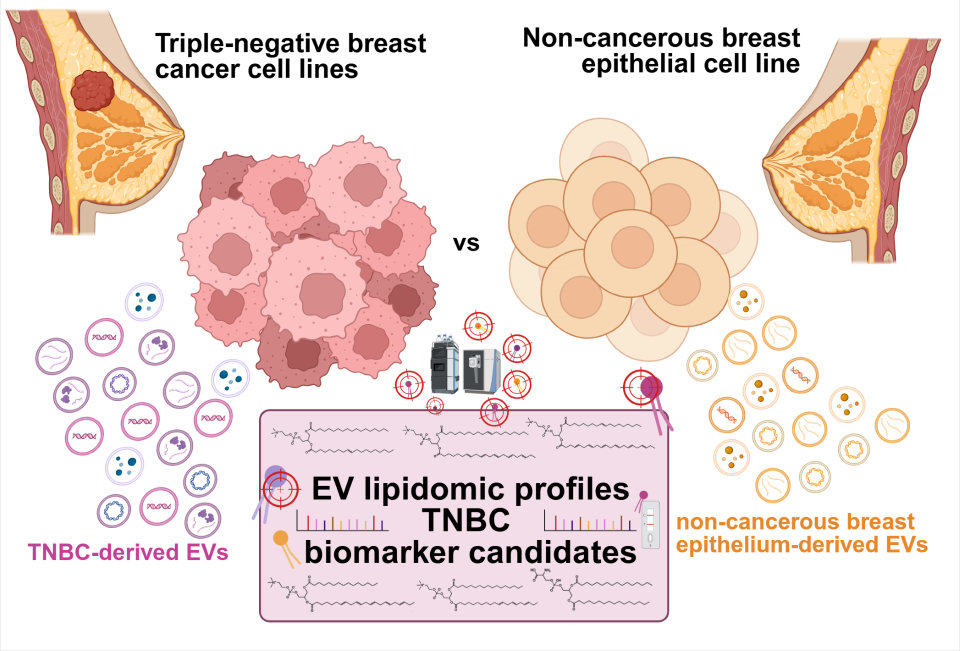
Breast cancer is a heterogeneous disease. Among its molecular subtypes, triple-negative breast cancer (TNBC) is the most aggressive, largely due to an insufficient understanding of its biology and the lack of well-defined molecular targets. One of the key events driving cancer metastasis is the epithelial-to-mesenchymal transition (EMT). EMT is a complex process in which cells undergo a series of changes leading to enhanced migratory and invasive capacities, contributing to the progression of cancer cells toward a metastatic state. In this study, we stimulate EMT and investigate the resulting changes quantitatively at the gene level and qualitatively at the protein level.
Another important aspect influencing cancer plasticity is intercellular communication mediated by extracellular vesicles (EVs) - nano- to microscale particles enclosed by a lipid bilayer and secreted by nearly all cell types. As the composition of EVs reflects their cell of origin, EV lipid profiles are likely to be cell type-specific, and thus differences are expected between EVs derived from cancerous and non-malignant cells. In this project, we investigate the lipid composition of EVs released by triple-negative breast cancer (TNBC) and non-malignant human breast epithelial cells, aiming to identify specific lipid profiles that might serve as potential biomarkers for TNBC. Together, these findings provide insight into molecular and lipidomic changes associated with TNBC and may contribute to improving diagnostic strategies and expanding the current repertoire of lipids used in lipid-based nanocarriers.
Project Members : Oliwia Majchrzak, Dr Olivier Jordan, Prof. Gerrit Borchard
External collaborators: Chirayus Khawsang, Dr. Eakachai Prompetchara, Dr. Chutitorn Ketloy
Keywords : extracellular vesicles, triple-negative breast cancer, epithelial-to-mesenchymal transition, lipidomics, biomarkers, nanocarriers